4 Pillars to Stop Losing Customers Today from Your Website

Key Takeaways
Most small business websites lose customers to friction, not price, through four invisible leaks: vague language, traffic mismatch, buried proof, and delayed answers.
Plain language beats jargon. If a stranger cannot explain what you sell after 10 seconds on your homepage, you have a translation problem, not a marketing problem.
Send visitors to a page that matches how they arrived. A dedicated landing page for your ad traffic, instead of a generic homepage, can turn an unprofitable ad campaign into a profitable one.
Doubt starts the moment you make a claim. Put a specific, result-oriented proof point next to your price, your buy button, and your boldest promise instead of burying it at the bottom of the page.
Answer hesitation in real time. Addressing the five or six questions that stall shoppers right at checkout can lift conversions by over 20 percent.
The "Invisible Leak": Why Your Website is Losing Money
Running a small business is a grind of pure dedication. You have likely poured your life savings, your sleep, and your pride into your product. Yet, there is a specific kind of pain that comes from watching your analytics: seeing hard-earned traffic arrive at your site, only to watch those visitors vanish seconds later without buying.
It is tempting to blame your pricing or your "dated" design, but 20 years of marketing data tells a different story. The reason people leave isn't usually the offer; it's friction. Most small business websites are "leaking" money through four specific, invisible holes that drive customers away before they even finish a sentence.
Think of these leaks as
Vague Language: Polished "corporate speak" that creates mental drag. Traffic Mismatch: Forcing every visitor through the same "front door" regardless of how they found you. Buried Proof: Hiding your credibility at the bottom of the page where no one sees it. Delayed Answers: Letting questions go unanswered until the customer has already moved on.
At Post Heritage, we act as the "expert mechanic" for your digital presence. We don't just give you a "shiny" new coat of paint; we get under the hood to find where your messaging is misfiring and where your conversion engine is losing compression. Fixing these leaks doesn't require a bigger advertising budget; it just requires re-aligning how you talk to your customers.

Pillar 1: The "Smart Friend" Test (Clarity Over Jargon)
Most business owners suffer from "Founder's Bias." You are so close to your industry that your jargon feels like plain English to you. But to a stranger, your "industry-standard" copy sounds like a foreign language. Confused people do not buy; they leave.
Plain language is a superpower. It isn't "dumbed down"; it's fast. Even high-level enterprise buyers are skimming. If they have to think too hard to understand what you sell, you've already lost. To pass the test, you must explain your business as if you were talking to a smart friend who knows absolutely nothing about your field.
Jargon vs. Reality
"Conversion-focused digital commerce solutions" becomes "We help online stores stop losing sales at checkout." "Holistic organizational transformation" becomes "We help companies stop losing their best people." "AI-powered workflow orchestration" becomes "We help teams stop chasing status updates."
The 10-Second Logo Test: To bypass your own bias, try this. Pull up your homepage, cover your logo, and hand the screen to a stranger for exactly 10 seconds. Ask them, "What do I sell?" If they hesitate, you don't have a marketing problem; you have a translation problem.
Post Heritage specializes in "Translation Audits." We strip away the boardroom nonsense to ensure your first line can be repeated back to you by a 12-year-old. Once the visitor understands what you do, we can move on to making them feel like the page was built specifically for them.
Pillar 2: Matching the Person, Not Just the Product (Consistency is King)
A major "mismatch bleed" occurs when businesses send all traffic- Search, Ads, and Social- to the same generic homepage. These visitors have completely different needs:
The Brand Searcher: They know you and are looking for validation, pricing, or confirmation. They need "proof up top" and findable facts. The Ad Clicker: They just saw a "scroll-stopping" ad 30 seconds ago. They have zero context. If your page doesn't immediately finish the sentence the ad started, they experience "Whiplash."
In marketing, we prioritize Continuity vs. Whiplash. Continuity is the "expert alignment" that makes a visitor feel safe. We recently saw a client spending $100,000 a month on ads that yielded zero profit because they were sending clicks to a generic homepage. By building a dedicated landing page that simply mirrored the ad's promise, those same ads became instantly profitable.
This is why we prioritize dedicated landing pages at Post Heritage. We focus on your most expensive traffic first to stop the "mismatch bleed" immediately, ensuring that your message matches the click every single time.
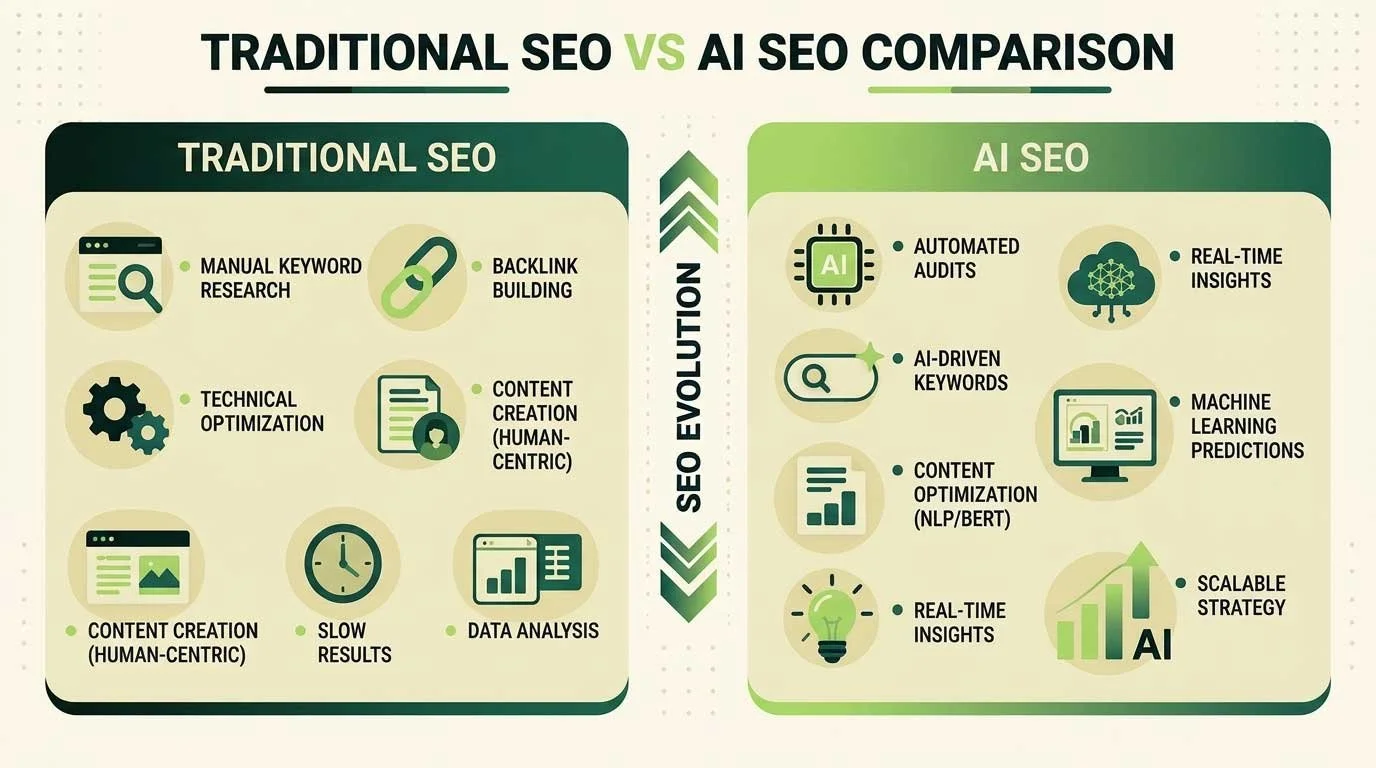
AI Overview citations drawn from the organic top ten have collapsed from around 76% in mid-2024 to between 17% and 38%. Optimizing the website for AI SEO is more important than ever.
Pillar 3: Prove It Before They Ask (The Power of Proximity)
Doubt is a reflex. The moment you make a claim, a visitor's brain asks, "Do you, though?" Most businesses bury their testimonials at the bottom of the page. By the time the visitor gets there, they've been doubting you for four scrolls.
The rule is: "The bolder the claim, the closer the proof." If you make a promise, the "receipt" must sit right next to it. A "receipt" isn't just a logo; it's a specific result-oriented sentence that proves your claim.
Checklist for Proof Placement
Next to the Price: To justify the cost and kill "sticker shock." Next to the "Buy" Button: To remove the last-second fear of commitment. Next to your Boldest Promise: To neutralize doubt the instant it forms.
Instead of a "logo wall" of eight generic icons, we implement the "two logos with receipts" strategy. For example:
Generic: "Trusted by industry leaders." (Weak) With Receipts: "Used by 214 dental practices, including three of the five largest in Texas." (Strong) With Receipts: "Average turnaround of 6 days across the last quarter." (Unbeatable)
Post Heritage helps you collect and strategically place these trust signals so that every "eyebrow-raising" claim is immediately supported by a concrete fact.

Pillar 4: Catching Them at the Moment of "No" (Real-Time Reassurance)
Hesitation peaks right at the point of commitment, usually the checkout or contact form. Visitors wonder about shipping, refunds, or if the product fits their specific situation.
Most businesses try to "fix" this with retargeting ads two days later. But by then, the "moment of interest" is dead. You need to catch them before the doubt hardens into a "no."
Hesitation vs. Solution
The Problem: The visitor hovers over the "Purchase" button but worries about your refund policy. The "Expert Mechanic" Fix: We implement AI-assisted real-time responses that surface the exact reassurance needed the moment the cursor drifts.
We've seen this strategy, addressing the five or six core questions that stall the "silent majority," lift conversions by over 20%. This is the cheapest way to grow because it focuses on the people who are already at your finish line. Post Heritage implements these real-time response strategies so no sale falls through the cracks.
Turning 20 Years of Insight into Your Advantage
When you fix these four pillars, you trigger a Compounding Effect. A clear message makes your landing pages easier to write, a matched page gives your proof a place to land, and proof lowers the hesitation that you are now catching in real time.
These fixes don't require a massive rebrand or a bloated advertising budget. They require a strategist who knows how to tighten the bolts on your messaging and re-align your funnels with human behavior.
While these steps are simple, they are incredibly hard to execute when you are "too close" to the business. You've spent years building your company; don't let a few "invisible leaks" drain your hard-earned profits.
Reach out to Post Heritage today for a professional audit. Let's identify your "invisible leaks" and turn your website into a high-conversion engine.